Wednesday, May 4, 2016

NY ATTORNEY GENERAL SCHNEIDERMAN AND CALIBER HOME LOANS | Lone Star Funds building a new Countrywide Financial? | FANNIE MAE AND FREDDIE MAC AND OH MY GOD

Eric T. Schneiderman, New York State’s attorney general, is investigating Caliber Home Loans, a mortgage lender owned by Lone Star Funds. Caliber Home has grown fast but also has drawn many complaints. Credit John Minchillo/Associated Press 
 
http://www.nytimes.com/2015/10/07/business/dealbook/new-york-attorney-general-examining-private-equity-firms-mortgage-business.html?_r=0
The rapid growth of Caliber Home Loans, a mortgage company owned by the private equity giant Lone Star Funds, has led to a surge in consumer complaints. Now it has led to regulatory scrutiny of Caliber’s business practices.  Eric T. Schneiderman, the New York attorney general, has opened an investigation into the mortgage company, a person in Mr. Schneiderman’s office confirmed.

Image result for lone star owner of caliber home loans
Caliber’s massive growth has been fueled in part by Lone Star Funds’ acquisitions of nonperforming loans from government-supported entities like HUD, Fannie Mae and Freddie Mac.
However, Lone Star Funds’ decision to tap former executives of disgraced lender Countrywide Financial raises questions about the firm’s ability to manage its explosive growth. The New York Times recently called Lone Star a “lightning rod, criticized by housing advocates and lawyers for borrowers.”  http://www.businesswire.com/news/home/20150929005648/en/UNITE-Lone-Star-Funds-building-Countrywide-Financial

TRUMP'S FOREIGN POLICY SPEECH PACK OF MORE LIES

TWSP/UFAA Morning Briefing for Wednesday, May 4, 2016

BERNIE DEFEATS HILLARY IN INDIANA; TRUMP TAKES STATE AS CRUZ QUITS; WALL STREET INSIDER TRUMP STILL FOOLING FOREIGN OBSERVERS WITH HIS STRATEGIC DECEPTIONS; TRUMP FOREIGN POLICY SPEECH IN HITLER TRADITION OF BIG LIES

Donald Trump’s foreign policy speech delivered last week has been widely exposed as a tissue of lies, but unfortunately normally sagacious foreign observers have made the blunder of believing some of the promises made by the fascist billionaire. In part, this is understandable, since it has been many decades since a liar of the caliber of Trump has played a central role on the international scene.
Trump is no threat to the US military industrial complex. Trump is not a threat to the WASP Establishment or any other establishment. Trump is not an outsider. Trump is a Wall Street insider who, already in 1991, was classified as Too Big to Fail and awarded a sweetheart bailout by the New York Federal Reserve, the US Treasury, and the Federal Reserve Board of Governors in Washington. Trump has no systematic idea of US foreign policy whatsoever. He is not a realist; he is closer to being a neocon, especially concerning ISIS and the Middle East. Trump is not a friend of Russia. Trump is not a noninterventionist. Trump is a cynical liar, megalomaniac, and sadist. Trump has been on all sides of all issues over several decades. Anyone taking Trump’s promises seriously is a glutton for punishment.
Perhaps the best way of illustrating Trump’s lies is first to refer them back to our Daily Briefing of last week, and then to focus this evening on the lies told by the Nazi dictator Adolf Hitler when he had just seized power in Germany, between 1933 and 1935.
There is no doubt that the methodology of the “Big Lie” used by Trump is precisely the one described by Hitler in his Mein Kampf, in which he aesthetically unveiled many elements of his technique. Concerning the art of lying, Hitler wrote:
‘All this was inspired by the principle—which is quite true within itself—that in the big lie there is always a certain force of credibility; because the broad masses of a nation are always more easily corrupted in the deeper strata of their emotional nature than consciously or voluntarily; and thus in the primitive simplicity of their minds they more readily fall victims to the big lie than the small lie, since they themselves often tell small lies in little matters but would be ashamed to resort to large-scale falsehoods. It would never come into their heads to fabricate colossal untruths, and they would not believe that others could have the impudence to distort the truth so infamously. Even though the facts which prove this to be so may be brought clearly to their minds, they will still doubt and waver and will continue to think that there may be some other explanation. For the grossly impudent lie always leaves traces behind it, even after it has been nailed down, a fact which is known to all expert liars in this world and to all who conspire together in the art of lying.’1
This was then the method, which Hitler and the Nazis relentlessly practiced on the German people, and on foreign governments around the world. Few demagogues in recent history have been able to match the shameless cynicism of Hitler’s lies. So if we are to deal with Trump effectively, we must go back to the source and remind ourselves of the multifarious forms which lies can assume, especially in international affairs.
Hitler had condemned the Versailles Treaty of 1919, shortly after coming to power, but he did not openly and officially denounce the limitations imposed on Germany’s Army, Navy, and Air Force until the spring of 1935, more than two years after he had seized power.
On March 16, 1935, Hitler announced a new decree law which established universal military service to create a peacetime standing army of 12 corps and 36 divisions totaling about half a million soldiers. This was an open repudiation of the military restrictions placed on Germany in the Versailles Treaty of 1919. At this point, German military forces were minimal, and there was no way to defend the country against France, Britain, or Poland. Britain, France and Italy met several weeks later at Stresa in Switzerland. This Stresa front condemned Hitler’s proclamation of German rearmament and insisted on the independence of Austria and continued respect for the postwar Locarno Treaty.
‘It was time, [Hitler] decided to pull out the stops again on his love of peace and to see whether the new unity of the powers arrayed against him might not be undermined and breached after all. On the evening of May 21, 1935 he delivered another ‘peace’ speech to the Reichstag – perhaps the most eloquent and certainly one of the cleverest and most misleading of his Reichstag orations that this writer, who sat through most of them, had ever heard him make. Hitler was in a relaxed mood and excluded a spirit not only of confidence, but – to the surprise of his listeners – of tolerance and conciliation. There was no resentment or defiance toward the nations which had condemned his scrapping of the military closes at their side. Instead, they were assurances that all he wanted was peace and understanding based on justice for all. He rejected the very idea of war; it was senseless, it was useless, as well as a horror.’2
This moment may perhaps be compared to last week, when Trump decided to restrain his hooligan instincts for a few hours and read some banalities off the teleprompter for the edification of international leaders and experts.
On May 21, 1935, Hitler delivered what was perhaps his most famous “peace speech” to the German Reichstag. Notice the frequency with which the Nazi dictator pronounces the word “peace.” Compare his cynical promises to his later deeds. This is lying when it is developed into a consummate art. This is the idiom of Hitler then, and it is the idiom of Trump today.
‘None of our practical plans will be completed before ten or twenty years to come; none of our idealistic objects will come to fulfillment in fifty or perhaps a hundred years. We all shall only live to see the first beginnings of this vast revolutionary development. What could I wish but peace and quiet? If any one says this is only the wish of leadership, I can reply, "the people themselves have never wished for war." Germany needs and wills peace? If [British Foreign Secretary]  Eden says such assurances mean nothing and that a signature under collective treaties is the sole guarantee of sincerity, I beg him to reflect that in every case it is a matter of what is assurance. It is often far easier to put one’s signature under a treaty with mental reservations as to what action to take later than to champion a pacific policy before the whole nation, because that nation rejects war.
I could have signed ten treaties, but that would not have the weight of the declaration made to France at the time of the Saar plebiscite. If I, as Fuehrer, give my assurance that with the Saar problem settled we will make no further territorial demands on France, this assurance is a contribution to peace which is more important than many a signature under many a pact. I believe that with this solemn declaration a quarrel of long duration between two nations really ought to be ended….Peace was not to be one of the one-sided right, but a peace of general equality, thereby of general right. It was to be a peace of reconciliation, of disarmament of all and thereby of security for all. From it was to result, as its crowning glory, the idea of international collective, cooperative effort of all States and nations in the League of Nations. I must from this place once more state emphatically there was no people anywhere who more eagerly took up these ideas than the Germans.
Germany refuses to be regarded and treated for all time as a second-class or inferior nation. Our love of peace perhaps is greater than in the case of others, for we have suffered most from war. None of us wants to threaten anybody, but we all are determined to obtain the security and equality of our people….With equality, Germany will never refuse to do its share of every endeavor, which serves peace, progress and the general welfare. The German Reich, especially the present German Government, has no other wish except to live on terms   of peace and friendship with all the neighboring States. Much as we ourselves love peace, it is not within our power to prevent the outbreak of conflicts between States, especially in the East.
The German Government is at all times ready to participate in collective cooperation for securing the peace of Europe, but it then considers it necessary to meet the law of eternal evolution by holding open the possibility of revision of treaties.
If people wish for peace it must be possible for governments to maintain it. We believe the restoration of the German defense force will contribute to this peace because of the simple fact that its existence removes a dangerous vacuum in Europe. We believe if the peoples of the world could agree to destroy all their gas and inflammable and explosive bombs this would be cheaper than using them to destroy one another. In saying this I am not speaking any longer as the representative of a defenseless State which could reap only advantages and no obligations from such action from others.
I cannot better conclude my speech to you, my fellow-figures and trustees of the nation, than by repeating our confession of faith in peace: Whoever lights the torch of war in Europe can wish for nothing but chaos. We, however, live in the firm conviction our times will see not the decline but the renaissance of the West. It is our proud hope and our unshakable belief Germany can make an imperishable contribution to this great work.’ 3
These siren promises were quickly followed by the unprecedented German rearmament, the reoccupation of the demilitarized Rhineland, the annexation of Austria, the Munich conference of September 1938, the complete absorption of what was left of Czechoslovakia in March 1939, and the Nazi demands on Poland later that year.
Then as now, the establishment media of the English-speaking world were eager to parrot Hitler’s lies, and Trump’s lies now. Indeed, Trump is a creation of the ruling class media who have given him more than $2 billion of free exposure, most often without any commentary, rebuttal, fact check, or other counterweight.
As a member of the Berlin press corps, William L. Shirer observed as the media betrayed civilization in conformity with their governments’ policies of whitewashing and appeasing Hitler:
‘Besides the Reichstag, Hitler had another means of communicating his peace propaganda to the outside world: the foreign press, whose correspondence, editors and publishers were constantly seeking interviews with him. There was Ward price, the monocled Englishman, and his newspaper, the London Daily Mail, who were always ready at the drop of a hint to accommodate the German dictator. So in August 1934, in another one of this series of interviews which would continue up to the eve of the war, Hitler told price – and his readers – that quote “war will not come again,” that Germany had “a more profound impression than any other of the evil that war causes,” that quote “Germany’s problems cannot be settled by war.” In the fall Hitler repeated these glowing sentiments to Jean Goy, a French war veterans’ leader and a member of the French Chamber of Deputies, who passed them on in an article in the Paris daily Le Matin.’4
Nor was Hitler’s practice of strategic deception limited to words and speeches alone. From the First World War, Hitler had drawn the strategic lesson that Germany was not in a position to attack and defeat all of its neighbors simultaneously. Rather, Hitler wanted to knock them off one by one. Despite traditional hostility between Poles and Germans, Hitler upon seizing power immediately offered Poland a nonaggression pact, which was quickly accepted by the Polish dictator Pilsudski.
The first major international treaty entered into by Nazi Germany was, surprisingly enough, a friendship and nonaggression pact with Poland:
‘The German–Polish Non-Aggression Pact (German: Deutsch-polnischer Nichtangriffspakt; Polish: Polsko-niemiecki pakt o nieagresji ) was an international treaty between Nazi Germany and the Second Polish Republic signed on January 26, 1934. According to the Pact, both countries pledged to resolve their problems through bilateral negotiations and to forgo armed conflict for a period of ten years. It effectively normalized relations between Poland and Germany, which were previously strained by border disputes arising from the territorial settlement in the Treaty of Versailles. As a consequence of the treaty, Germany effectively recognized Poland's borders and moved to end an economically damaging customs war which existed between the two countries during the previous decade….The 1934 Polish-German non-aggression pact, soon followed by a trade agreement with Germany, is said to have granted Germany a settled eastern border and allowed Hitler time for rearmament; five years later, he went on to successfully invade Poland.’5
German ambassador, Hans-Adolf von Moltke, Polish leader Józef Piłsudski, German propaganda minister Joseph Goebbelsand Józef Beck, Polish Foreign minister meeting in Warsaw on June 15, 1934, five months after signing the Polish-German Non-Aggression Pact.
Pilsudski realized that he had become a prime target for aggression as soon as Hitler had seized power in January 1933. Pilsudski’s goal had been to gain time by seeking to ensure that he would not be the first of the Nazi targets. As it turned out, he was not the first, but rather the last before the outbreak of World War II just five years later in 1939.
The other peaceful overture accomplished during the early phase of Hitler’s power was the Anglo German Naval Agreement of June 1935, which established the pattern of appeasement or indirect support given to the Nazis by Britain and France. This agreement encouraged Germany to rearm well above the limits included in the Versailles Treaty:
‘The Anglo-German Naval Agreement of June 18, 1935, was a naval agreement between Britain and Germany regulating the size of the Kriegsmarine in relation to the Royal Navy. The Anglo-German Naval Agreement fixed a ratio whereby the total tonnage of the Kriegsmarine was to be 35% of the total tonnage of the Royal Navy on a permanent basis. It was registered in League of Nations Treaty Series on July 12, 1935. The agreement was renounced by Adolf Hitler on April 28, 1939.'  6
Lord Halifax with Hermann Göring at Schorfheide, Germany, 20 November 1937.
In retrospect, all these peace overtures, peace, speeches, and charm offensives were revealed to be nothing more than stepping stones towards the next world war. The politicians and statesmen who put any credence in Hitler’s fakery were later reviled as sellouts and appeasers, and with good reason.
After Munich, Hitler said: “I have no further territorial demands in Europe.” But of course he did – he wanted the rest of Bohemia and Moravia, and then he wanted parts of Poland.
If we look at Trump’s foreign policy speech of last week, we see a similar tissue of lies. Experienced international observers must now see the fact that fascism has returned in grand style to the world stage after a 70-year absence, and that political leaders must unite to oppose the threat of a new fascist era which not everyone is morally and intellectually capable of understanding with the necessary speed.
  1. Adolf Hitler, Mein Kampf, vol. I, ch. X
  2. William L. Shirer, The Rise and Fall of the Third Reich (New York: Simon and Shuster, 1960), p. 285.
  3. Hitler, Speech to the Reichstag, May 21, 1935.
  4. Shirer, pp. 280-281.
  5. https://en.wikipedia.org/wiki/German%E2%80%93Polish_Non-Aggression_Pact
  6. https://en.wikipedia.org/wiki/Anglo-German_Naval_Agreement 
    This morning briefing is distributed free of charge. To subscribe, visit http://twsp.us/briefing or send an email with the subject “Subscribe” to taxwallstreetparty@gmail.com.
    All contents © Tax Wall Street Party / United Front Against Austerity unless otherwise noted. You are encouraged to share links to twsp.us but may not republish the contents of this newsletter without attributing credit to the author and linking to the website, or without written permission of the publisher. For permission, please write to taxwallstreetparty@gmail.com with details about your publication.

Monday, May 2, 2016

VOTES DON'T GET ALL COUNTED | GREG PALAST NEEDS TO COMPLETE HIS NEW FILM


- See more at: http://www.gregpalast.com/palast-larry-kings-politicking/#sthash.Ra7jEqXz.dpuf

JOHN FITZGERALD MOLLOY 1917-2008-“The Fraternity – Lawyers and Judges in Collusion” published by Paragon House, 2004

Posted on
“The Fraternity “ Lawyers and Judges in Collusion” published by Paragon House, 2004.
Written by John F. Molloy.
John Fitzgerald Molloy died at his home, encircled by the love of his family, early on July 12, 2008. He fought a courageous and tenacious battle against cancer (30 years of prostate cancer and five years of colorectal cancer) and other ailments that could not slow him down until his final months.
He filled his 90 years with adventures and accomplishments in an illustrious career as lawyer, judge, author, pilot, tennis aficionado, father, grandfather and much more. Born on August 18, 1917, in Los Angeles, Calif., John Molloy was raised in Yuma where his father, Thomas D. Molloy, served as Yuma County Attorney in the early days of Arizona statehood. John Molloy left Yuma to study at the University of Arizona, where he earned his BA in 1939 and his JD in 1946. In between he served his country in the Pacific as a US Navy pilot 1941 – 45, and retired as a Captain in the Naval Reserve.
His distinguished legal career began as a trial lawyer with Hall, Catlin & Molloy, 1946 – 57; Pima County Superior Court Judge, 1957 – 61; Founder of Pima County Court of Conciliation, 1960; Arizona Court of Appeals, 1961 – 67; Chief Judge of the Court of Appeals, 1967 – 69; and president of the largest law firm in Southern Arizona, Molloy, Jones, Donahue, 1969 – 1991. He authored more than 300 decisions for the Arizona Court of Appeals and the final Miranda decision for the Arizona Supreme Court.
He also wrote a well-received book, “The Fraternity – Lawyers and Judges in Collusion” published by Paragon House, 2004. Many local attorneys prepared for their State Bar exams by taking the extensive Bar Review course John Molloy taught for a decade. His community leadership positions included: National Law Center for Inter-American Free Trade; president of the Marshall Foundation for 26 years; appointment to Arizona Board of Regents by Gov. Raul Castro; president of the Tucson YMCA; commander of American Legion Post 7; visiting professor, UA College of Law; president of Arizona Judges Association and affiliation with the major bar and legal associations. He has served on the Boards of Arizona Health Sciences Center, Sarver Heart Center, Little Chapel of All Nations, El Pueblo Health Center, Arizona Children’s Home, Child Guidance Clinic and St. Elizabeth of Hungary Clinic. He received a UA Honorary Doctorate of Laws in 1986 and UA Distinguished Citizen Awards in 1975 and 1994. And on top of any of his roles as a Tucson community leader, he always put family and loved ones first. His family will always feel the love and power of his presence as a great patriarch. He often said that he could live on forever through his children and descendents, and almost every day he would exclaim to everyone, “Life is good!” A public memorial service and celebration of John F. Molloy’s life will be held Saturday, July 19, at 4:00 p.m. at Christ Presbyterian Church, 6565 E. Broadway, followed by an off-site reception. In lieu of flowers, the family invites gifts to causes such as the YMCA and the UA Sarver Heart Center. Arrangements by BRING’S BROADWAY CHAPEL, 6910 E. Broadway.
Published in the Arizona Daily Star on July 16, 2008
– See more at: http://m.legacy.com/obituaries/tucson/obituary.aspx?n=&pid=113487068&referrer=0&preview=True#sthash.wKf0uBME.dpuf
>>https://artdailyprayer.wordpress.com/2016/05/02/legal-bubble-john-f-molloy-the-fraternity-lawyers-and-judges-in-collusion/<<

Saturday, April 30, 2016

U.S. CONSTITUTION IS WORTH THE HARD WORK FOR YOU MR. DAO SANCTUARY DIVINE BEING

>>https://drive.google.com/file/d/0B1LLz-ESkJjDSGQ1UTVPOU9adjRDaVZRYW5mVWFaYV9KWTFR/view?usp=sharing<<

JAMES KIDNEY FORMER SEC ATTORNEY CAN BE THE HUCKLEBERRY FOR AMERICA OH HOW PROMISING


By Pam Martens: December 15, 2014

Today we welcome former SEC attorney, James A. Kidney, as a guest columnist to our front page. Mr. Kidney brings 25 years of SEC experience and wisdom to the conversation. Here’s the backdrop:

The U.S. Department of Justice has been burning through millions of dollars of taxpayer money chasing down suspected insider traders who are four and five times removed from the person leaking inside information; convening grand juries to indict the traders; convincing trial courts to send them off to prison. The Securities and Exchange Commission has gone after the same individuals, banning them for life from the industry. That’s the same DOJ and SEC that have failed to bring charges against one CEO of a major Wall Street firm for the crash of 2008 — the greatest and most corrupt financial collapse since the Great Depression.

Last week, in a wide-reaching decision, the U.S. Court of Appeals for the Second Circuit, in United States of America v Todd Newman, Anthony Chiasson effectively advised Americans that the Department of Justice has grossly misapplied insider trading laws. And since the SEC has targeted the same individuals using the same legal principle, the decision means the SEC also doesn’t understand the laws it is supposed to be carrying out.

In a nutshell, the Court found that to be guilty of a crime the person trading on inside information has to have knowledge that the inside tipster breached a duty of trust to the corporation in exchange for a personal benefit. That knowledge was missing in many of these traders who were four and five times removed from the tipster. In fact, the court found that there may not have even been a tangible personal benefit to the tipster.

In simple terms, if a corporate insider gives material non-public information to a trader in exchange for cash or something of value, and the same trader then trades on that information, that’s a classic case of insider trading. But when the traders have no knowledge of any personal benefit given to the tipster, there is no insider trading crime.

Whether this is good law or bad can be debated. For example, corporate insiders might leak information for no current personal benefit on the hope or expectation that in the future they’ll be rewarded with a plum job and fat compensation at the trader’s firm. (That form of quid pro quo is a staple on Wall Street.)

The message the Appeals Court might have been subtly sending to the DOJ and SEC is to stop casting their wide net at people four times removed from a crime scene and go after the real criminals on Wall Street whose past and current actions pose a real and pressing danger to the entire financial system.

We turn the discussion over to James A. Kidney, who caused quite a stir earlier this year in a speech at his retirement party criticizing SEC management for policing “the broken windows on the street level” while ignoring the “penthouse floors”.


Finding the Courage to Go After the Big Fish 

By James A. Kidney: December 15, 2014

James A. Kidney, Former SEC Trial Attorney

Most of the highlights of my 25-year career as a trial attorney at the Securities and Exchange Commission involve the half dozen or more insider trading cases I tried before juries.  I was lead counsel in the very first jury trial the SEC ever brought – an insider trading case in Seattle in 1989.  I prevailed on behalf of the SEC in every one of my insider trading trials.

I wish I could say these victories achieved something important for securities enforcement.  I doubt that they did. Those cases tried against other than true corporate insiders were largely a waste of government (and my) time.  As were the far more numerous such cases which settled without trial, sometimes for substantial sums by any standard, and sometimes by such small sums they were substantial only to the middle class sap who acted on a stock tip and had the misfortune to be persecuted by the SEC.

Investigating and litigating insider trading cases are probably the most fun the SEC Enforcement staff has as it muddles around the oft-amended, often confusing statutes and rules embedded in 70 year old basic securities laws that are long past their sell-by date.  Of all the common securities law claims brought by the SEC as civil cases (and, sometimes, by the Department of Justice as civil or criminal matters), insider trading requires investigations that are the most like Sam Spade detective work as seen on film and television.  Insider trading is often like finding out who killed Colonel Mustard in the library with a candlestick. I know I enjoyed them, even as I doubted their utility.

The investigation team at the SEC (and the U.S. attorneys’ offices) first have to figure out if information was leaked from a corporate source. Maybe the trading on good or bad news was a corporate source using a beard, such as a friend or neighbor.  Maybe the corporate source was getting paid, in cash, favors, future employment, or some other benefit, for passing on material nonpublic information to a stock trader.  It is fun trying to track down the inside source, usually working backwards from someone who made a timely purchase or sale in advance of good or bad corporate news.  Finding the key telephone call or other communication and then springing the evidence on the defendant in a deposition or courtroom is a thrill rare in the annals of securities litigation.  A little like Perry Mason, if I may date myself.

In addition to working backwards to the source, the staff usually will also work forward, finding persons who traded at several levels removed from the insider.  I have tried cases, and prevailed in front of juries, in which the defendant was several levels removed from the insider.  In my most extreme case, the defendant was five levels removed from the original source of the information.  The source was supposedly the brother of a guy who worked for the company and received information from his brother.  The brother called his broker – but didn’t trade himself when the broker told him doing so would be illegal.  But the broker couldn’t keep his mouth shut and told some of his customers, who told their friends, who told their friends. The SEC sued about a dozen people in this chain (but not the original insider).  All but the fifth level guy settled. We tried the case against him, a high school dropout who operated a scaffolding company and who was his own lawyer.  After a four-day trial in front of a senior federal judge, the SEC prevailed with the jury.  Whooo Hoo!  Markets saved.

In my view, as a recently retired SEC trial lawyer, the Commission spends far too many resources on pursuing low level “insider traders” who are far removed from the corporate suite.  Most of these cases have zero impact on market prices or practices.  So-called “remote tippee” cases employ legal fictions that are fuzzy at best and often outright unfair and unrealistic.  Insider trading cases rely on “legal fictions” of transferred duties from the insider to one tippee, to another tippee, to a third tippee, who might have been tipped on the golf course by a friend who vaguely says he got it from a guy who knew a guy at the subject public company.  These actions put the emphasis on “fiction” in legal fiction.

Such cases are not by any means the only waste of enforcement resources.  The Commission staff typically spends much time near the end of the fiscal year (September 30) boosting its enforcement numbers with window dressing cases, such as administrative follow-ons to criminal convictions, some years old, filing actions to deregister defunct corporations and bringing minor administrative actions against corporate officers who fail to report stock transactions as required by law.  The press and Congress, as well as the Commissioners themselves, want the enforcement numbers pumped up.  And the press uncritically considers the raw enforcement numbers a measure of the success or failure of the Division of Enforcement.  No matter if large numbers of cases are the equivalent of jaywalking tickets while banks are being robbed (or, rather, doing the robbing).  The numbers are up!  Again, Whooo Hoo!

This practice is defended by the current SEC chair and the current director of the Division of Enforcement as the “broken windows” theory of “law enforcement,” as if big Wall Street firms gave a dam whether a smalltime Joe got nailed by the Big Bad SEC.  As is well-known, much of the SEC docket is devoted to enforcement against such small timers.

“Broken windows” might be tolerable, if the SEC staff did not also shy away from the big picture windows on the upper floors of Wall Street.  I know from personal experience at the SEC that the Division of Enforcement has been loath to bring perfectly colorable fraud actions against more senior insiders at the big banks that brought us the 2008 financial crisis and their large customers.  Division of Enforcement senior management, presumably at the behest of the chairman at the time, actually had a virtual template for the SEC staying its hand in other cases involving other large Wall Street institutions – grab a big fine from the institution and sue a very small fry.  After all, a firm like Goldman Sachs will let a junior vice president peddle a billion dollar product with no supervision, right?

I often pictured some banking fat cat reading a headline about the SEC or DOJ nailing some “broken windows” defendant and thinking, “Keep it up.  Leave me alone.”

All of which brings us to the good news about last week’s decision by a panel of the U.S. Court of Appeals for the Second Circuit in U.S. v. Newman.   In that criminal case brought by the Office of the U.S. Attorney for the Southern District of New York, the court unanimously held that the prosecutor must prove that remote tippees knew that the original insider who provided material nonpublic information did so in return for a personal benefit.  This was a straightforward reading of a 30-year-old Supreme Court decision which the SEC and the Justice Department over the years had turned into a practical nullity in remote tippee cases such as Newman.

The press reaction has been all about how damaging this decision will be to insider trading enforcement. Yes, it will serve as a major deterrent to bringing enforcement actions, civil or criminal, against remote tippees who had no personal contact with the corporate insider and often do not even know his or her name or corporate position. Until now, as a practical matter, the prosecution had only to persuade a jury that a remote tippee defendant had sufficient facts to know, or, in an SEC civil case, was reckless in not knowing, that the information on which the defendant traded likely came from an insider corporate source, that it was material and that at the time the defendant made the trade it was still nonpublic. In other words, that the defendant knew he was acting on what he thought was a “hot stock tip.”

Of course, the defendants in U.S. v. Newman were not small fry. They were traders employed by crème de la crème hedge funds, which is why the reversal and dismissal of their criminal convictions and long white collar prison sentences causes such consternation.  But acting on a hot tip, even knowing that it probably came from a corporate insider (and thus was more reliable than mere gossip) stretches notions of securities fraud far beyond safe boundaries for society. The rules of proper behavior are too ill-defined when information is received far from its source, even if the defendants or their employers are among the One Percent, as in Newman.  Most important, remote tippee insider trading does little economic damage to the markets — certainly far less damage than the billion dollar deals put together by Wall Street and sold as relatively safe when they are in fact built on soft mud – but it’s an easy win and fun to work on, at least at the SEC.

I don’t go along with those who say insider trading should be legal because it adds information to the market through trading. I am very skeptical of the whole efficient markets theory, and there are concrete reasons to bar insiders from benefitting from corporate information.  Insiders are paid a salary and often bonuses – sometimes quite large – and should not be taking advantage of their position for additional personal gain, especially at the expense of shareholders lacking the inside information and, therefore, willing to trade their shares.  Nor should they be permitted to advantage their friends and relations by tipping them to inside information as a gift.  The court’s decision in U.S. v. Newman does not change the existing law in this regard.

The really good news about U.S. v. Newman, should it not be reversed on appeal or circumvented by clever SEC and DOJ lawyers, is that all those resources spent in going after remote tippee defendants such as those I made a career of prosecuting (at the direction of my bosses) can now be used to ferret out conduct far more damaging to the markets and, sometimes, the economy. That is, if the aforementioned SEC and DOJ ever find the courage to do so.

WALL STREET AND ARCHANGEL MICHAEL DOING BATTLE? OFFICE OF THE COMPTROLLER OF THE CURRENCY NEEDS THE ANGELS AND ARCHANGELS ALL IN THE TIME THAT IS


>>Is the Wall Street Cartel Regrouping? Regulator Fires Warning Shot<<  By Pam Martens and Russ Martens:

Bethany Dugan, Deputy Comptroller for Operational Risk at the OCC
 April 28, 2016 
Bethany Dugan, Deputy Comptroller for Operational Risk at the OCC
Remember the chat rooms dubbed “The Cartel” and “The Bandits Club” that contributed to felony counts against the mega Wall Street banks last May for rigging the foreign currency markets? How about that classic from the Barclays chat room trader: “if you aint cheating, you aint trying.”
Well, apparently, one or more banks are causing concerns in this area again.
Yesterday, the regulator of national banks, the Office of the Comptroller of the Currency, sent out a severe warning to its flock that there could be a five year jail sentence waiting in the wings for anyone attempting to use technology to block its mandated access to bank records. The letter was authored by Bethany Dugan, Deputy Comptroller for Operational Risk. The statement read in part:
“The OCC has become aware of communications technology recently made available to banks that could prevent or impede OCC access to bank records through certain data deletion or encryption features.” Another part of the memo honed in on the chat room issue, noting that “…OCC is aware that some chat and messaging platforms have touted an ability to ‘guarantee’ the deletion of transmitted messages. The permanent deletion of internal communications, especially if occurring within a relatively short time frame, conflicts with OCC expectations of sound governance, compliance, and risk management practices as well as safety and soundness principles.”
Curiously, a footnote called out the Board and bank management of unnamed banks, suggesting that there has been a concerted effort to block the OCC examiners from access to chat rooms and/or to speak directly to bank staff:
“Failure to provide timely access, or efforts by the board of directors or bank management to impede the bank staff’s ability to provide such access, may result in enforcement action. Furthermore, examination obstruction may subject individuals to criminal prosecution. Refer to 18 USC 1517, ‘Obstructing Examination of Financial Institution.’ ”
The statute referenced by the OCC, 18 USC 1517, is succinct and harsh: “Whoever corruptly obstructs or attempts to obstruct any examination of a financial institution by an agency of the United States with jurisdiction to conduct an examination of such financial institution shall be fined under this title, imprisoned not more than 5 years, or both.”
Wall Street watchers are speculating that this may be another dustup over the communications system called Symphony that was initiated by Goldman Sachs. Goldman provides a detailed explanation on its web site about how it built out this system and admits that it got a “consortium” of other mega banks and hedge funds to join its plan. It also explains how it hired an expert in “encryption” to head it up, writing:
“In an effort to further develop and evolve the platform, Goldman Sachs built a consortium of the world’s leading financial services firms and acquired Perzo, a Palo Alto startup led by David Gurle, an expert in encryption and security, to form Symphony Communication Services Holdings LLC.”
In a press release issued in 2014, Symphony said that its financial institution partners, in addition to Goldman, included: Bank of America Merrill Lynch, BNY Mellon, BlackRock, Citadel, Citigroup, Credit Suisse, Deutsche Bank, Jefferies, JPMorgan, Maverick, Morgan Stanley, Nomura and Wells Fargo.”
The New York State Department of Financial Services was sufficiently concerned about the encryption aspect of the Symphony platform that it reached an agreement with four of the banks that it regulates (Goldman Sachs, Deutsche Bank, Credit Suisse, and Bank of New York Mellon) in September of last year.
Anthony J. Albanese, Acting Superintendent of Financial Services, said at the time of the agreement: “We are pleased that these banks did the right thing by working cooperatively with us to help address our concerns about this new messaging platform. This is a critical issue since chats and other electronic records have provided key evidence in investigations of wrongdoing on Wall Street.  It is vital that regulators act to ensure that these records do not fall into a digital black hole.”
Initially, Symphony was promoting its platform with a promise of “Guaranteed Data Deletion,” raising red flags among New York State regulators.
Under the agreement with the State of New York, the four banks agreed to retain a copy of all e-communications sent through the Symphony platform for seven years and store duplicate copies of the decryption keys for these communications with independent custodians not controlled by the banks. The other 10 financial firms partnering with Symphony were not, however, parties to the agreement.
The specific language in the agreement noted that the Symphony platform uses “end-to-end encryption” which “enables the transmission of encrypted messages – including chat and instant messages – where only the sender and recipient institutions can decrypt the message using a private decryption key, and Symphony does not have the ability to decrypt the message.”

Why the Vampire Squid Wants Small Depositors’ Money in 1 Frightening Chart

By Pam Martens and Russ Martens: April 27, 2016
Goldman Sach's Advertising Slogan Is "Progress Is Everyone's Business."
Goldman Sach’s Advertising Slogan Is “Progress Is Everyone’s Business.”
Back in 2010, with the public still numb from the epic financial crash and still in the dark about the trillions of dollars of secret loans the Federal Reserve had pumped into the Wall Street mega banks to resuscitate their sinking carcasses, Matt Taibbi penned his classic profile of Goldman Sachs at Rolling Stone, with this, now legendary, summation: “The world’s most powerful investment bank is a great vampire squid wrapped around the face of humanity, relentlessly jamming its blood funnel into anything that smells like money.”
Historically, what smells like money to Goldman Sachs has been eight-figure money and higher. As recently as 2013, the New York Times reported that Goldman had a $10 million minimum to manage private wealth and was kicking out its own employees’ brokerage accounts if they were less than $1 million. Now, all of a sudden, Goldman Sachs Bank USA is offering FDIC insured savings accounts with no minimums and certificates of deposits for as little as $500 with above-average yields, meaning it’s going after this money aggressively from the little guy. What could possibly go wrong?
The last utterances we ever hoped to see bundled into a bank promotion were the words “Goldman Sachs” and “FDIC insurance” and “peace-of-mind savings.” But that’s what now greets one at the new online presence of Goldman Sachs Bank USA, thanks to the repeal of the Glass-Steagall Act in 1999, which allowed high-risk investment banks like Goldman Sachs to also own FDIC-insured, deposit-taking banks.
Goldman Sachs has been paying lots of fines for wrongdoing in the past few years, topping off at a cool $5 billion earlier this month for what the U.S. Justice Department characterized as “serious misconduct in falsely assuring investors that securities it sold were backed by sound mortgages, when it knew that they were full of mortgages that were likely to fail.” There was also the $550 million settlement in 2010 with the SEC for Goldman allowing the hedge fund run by billionaire John Paulson to secretly assist it in creating a portfolio designed to fail so Paulson could short it, while Goldman sold it to its own clients without divulging this pesky detail.
Students of Wall Street history may also recall that Goldman’s hubris leading up to the crash of 1929 played a role in why the Glass-Steagall Act of 1933 banned casino-like investment banks from getting near insured deposits. Prior to the ’29 crash, Goldman ran the Goldman Sachs Trading Company, a closed end fund (called a trust in those days). Goldman Sachs also offered that deal to the little guy at $104 a share. The fund appeared to investigators as a dumping ground for Goldman while also paying it a hefty management fee. The little guy who bought the shares at $104 a share at the top of the bull market was left with about a buck and change after the ’29 crash.
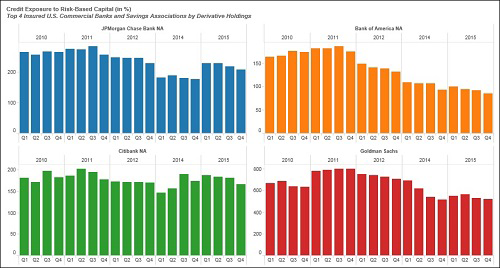
So why this generous move now by Goldman Sachs Bank USA to offer above average returns to the little guy? It likely has a lot to do with the chart below from the Office of the Comptroller of the Currency’s (OCC) December 31, 2015 report on the four largest banks based on derivatives exposure. According to the report, the credit exposure from derivatives versus the bank’s risk-based capital is as follows: JPMorgan Chase 209 percent; Bank of America 85 percent; Citibank 166 percent and Goldman Sachs (wait for it) – a whopping 516 percent.
Not to put too fine a point on it, but you might recall that one of the key promises of the Dodd-Frank financial reform legislation was that after the largest bank bailout in financial history in 2008, these derivatives were going to be pushed out of the insured bank into bank affiliates that would not endanger the taxpayer-backstopped deposits and force another monster taxpayer bailout in the next crisis. This became known as the “push-out rule” which could never seem to materialize into a hard and fast law. Then, in December 2014, Citigroup simply used its muscle to legislate the rule out of existence.
The Obama administration also promised that Dodd-Frank would put an end to these trillions of dollars of opaque derivatives being traded in the dark between firms as private contracts (over-the-counter). Dodd-Frank promised to bring them into the sunshine at central clearinghouses. But the December 2015 report from the OCC makes clear that’s just another failed promise, stating:
“In the first quarter of 2015, banks began reporting their volumes of cleared and non-cleared derivatives transactions, as well as risk weights for counterparties in each of these categories. In the fourth quarter of 2015, 36.9 percent of the derivatives market was centrally cleared.”
According to the OCC, as of December 31, 2015 there were $237 trillion in notional derivatives (face amount) at the 25 largest bank holding companies with the bulk of that amount on the books of the insured banks. That compares with $169 trillion on the books of the 25 largest bank holding companies at December 31, 2007, just prior to the implosions on Wall Street. This means there has been an explosive 40 percent increase in eight years when the Obama administration was supposed to be reining in risk on Wall Street.
When you hear Hillary Clinton repeatedly tell the public that she wants to continue along the same pathways as President Obama and that the restoration of the Glass-Steagall Act is not needed, let the image of Goldman Sachs Bank USA and its FDIC insurance logo and its $41 trillion in derivatives come to mind.
Four Largest Banks by Derivatives -- Ratio of Credit Exposure to Risk-Based Capital: OCC Report Dated December 31, 2015
Four Largest Banks by Derivatives — Percentage Ratio of Credit Exposure to Risk-Based Capital: OCC Report Dated December 31, 2015